02/05/10: Topii making. Made a lot of topiis! 8-9 different kinds with paper! Then solved some puzzles on demand! That's the first thing they asked for! Pooja, Priti, Mahesh, Irfan, Tushar, Akshay, - attendance in photos! Will upload soon!
Showing posts with label Activities. Show all posts
Showing posts with label Activities. Show all posts
Thursday, September 11, 2014
Topi-logy!
02/05/10: Topii making. Made a lot of topiis! 8-9 different kinds with paper! Then solved some puzzles on demand! That's the first thing they asked for! Pooja, Priti, Mahesh, Irfan, Tushar, Akshay, - attendance in photos! Will upload soon!


Wednesday, September 10, 2014
I loved this class!
05 - Jul - 2009 (Sun)
A long standing problem was addressed in this class. A lot of kids do a lot of things in class, many a times! Today, kids were asked to interview themselves and people from their area on "How a class should be"! The interviews + kids' thoughts were put together and the kids themselves made rules on how they should behave in the class. These rules are now stuck on the classroom door and kids seem to follow them so far! :) This class was a long one and describing it in words is something I won't be able to so I won't even attempt!
Next class:
Played a lot at BC. Didii was late and hence, according to the rules made by the kids, she was to be punished. They unanimously agreed upon no-studies-only-play punishment for Didii! :) 2 new volunteers Deepika and Ranjini had come to the class, and playing a game together helped in better bonding of new Didiis and the kids.
Sagar!
Ajay says:
Hi everyone.
Here is the update for the session on 22/01/2012.
Ruby didi brought her friend Sagar to class. The kids were really excited to meet him. They gathered round him and started talking with him. Sagar shared a lot of jokes with the kids. Sagar also imitated various filmstars. The kids found this highly entertaining. Sameer in particular jelled well with Sagar.
Later, Sagar showed the kids his watch. The kids were amazed at his ability to read time from a braille watch. He later took out his stick. Sachin Bhaiyya and I asked the kids if they remembered the basic features of the stick. To our delight, most of them did.
Sagar later told the children about himself about his passion for music and how he copes and manages daily. Sagar also explained to the children the concept of braille. Then the class recited the song, "Little drops of water and sand make the ocean and the great land."
Phir, Sagar ne hamari shyam aur bhi haseen bana di. Ek badhiya raag gaa kar unhone hamara man jeet liya.
We then concluded the session.
This brilliant entertainer Sagar sure was a treat to all! Hope he returns!
Tuesday, August 13, 2013
Listen!
This happened on 25/07/2009. Just noting it here since it is one of those innovative activities that I now think should have been documented well. Today, many a times I find it difficult to explain to newer volunteers what kind of creative ideas we have been implementing apart from regular studies.
Anyway, here it comes:
LOTS of new volunteers had come on that day. In those days, volunteers would just come to the little multipurpose community room inside Patil Estate without ANY orientation, which usually created more problems than any help to those conducting the class. Anyway. Had to involve all of them along with the kids.
Made 6-7 groups having 2 kids and 1 volunteer each. Explained the activity to all: We are to leave from this room and walk till Boat Club aka BC (inside CoEP, 8-10 minutes walk from the slum if all goes well, :-) ) with our mouths shut. We will only keep our eyes and ears and other senses open to reception and note things around us. We will discuss our observations only after we reach our destination.
And thus our mute parade reached Boat Club and settled. Only then we started speaking. Asked kids to be ready with their notebooks and pens. Then came the first discussion topic: "What did you observe? If you were to hypothetically label the observations as 'Good' or 'Bad' (their, or rather, everybody's favourite labelling), how would you do it?" Each of them were asked to speak one by one.
"Didi, I saw 2 boys fighting near lane no. 10. They were hitting each other! It was very bad!" -Irfan. Then we all discussed a bit on fighting and all of them decided- along with Irfan (at least in theory)- that it was 'bad'. All noted this down in the 'Bad' column in their notebooks. (Tip: Every activity can be so subtly linked with writing that kids never realize they are performing any writing tasks.) Now came the fun part. Since Irfan first observed this and termed this as 'bad', he should not indulge into it and set an example by never fighting! All of them noted this down eagerly so that it gets written down and they can refer to it later and remind Irfan!
This then happened for everyone. Kids remembered each others' points and kept reminding each other for the next couple of months. :')
Here are some of the other observations:
"That bridge we crossed was such a good bridge! I observed it. I will make one, one day!"
"People honk unnecessarily! Bad!"
"How they drove near that signal, didi! Too fast! Bad!"
"Because we didn't talk unnecessarily, we could observe so many things we never observed on our everyday route! Very good!"
"One car was giving out black smoke. Bad."
"They were leaving the taps open, letting water waste... Not good."
"I heard the birds!"
"There was too much noise outside but once we entered the campus, it is much better."
"There's a lot of garbage at the banks of the river."
"He tried to speak while on the way even when we all had decided not to!"
.
.
.
One of the volunteers asked me after the class: "Is this what you do? What's the whole point of this? I mean, what's the use?!"
Would you like to answer him? If yes, then please leave a comment! :')
LOTS of new volunteers had come on that day. In those days, volunteers would just come to the little multipurpose community room inside Patil Estate without ANY orientation, which usually created more problems than any help to those conducting the class. Anyway. Had to involve all of them along with the kids.
Made 6-7 groups having 2 kids and 1 volunteer each. Explained the activity to all: We are to leave from this room and walk till Boat Club aka BC (inside CoEP, 8-10 minutes walk from the slum if all goes well, :-) ) with our mouths shut. We will only keep our eyes and ears and other senses open to reception and note things around us. We will discuss our observations only after we reach our destination.
And thus our mute parade reached Boat Club and settled. Only then we started speaking. Asked kids to be ready with their notebooks and pens. Then came the first discussion topic: "What did you observe? If you were to hypothetically label the observations as 'Good' or 'Bad' (their, or rather, everybody's favourite labelling), how would you do it?" Each of them were asked to speak one by one.
"Didi, I saw 2 boys fighting near lane no. 10. They were hitting each other! It was very bad!" -Irfan. Then we all discussed a bit on fighting and all of them decided- along with Irfan (at least in theory)- that it was 'bad'. All noted this down in the 'Bad' column in their notebooks. (Tip: Every activity can be so subtly linked with writing that kids never realize they are performing any writing tasks.) Now came the fun part. Since Irfan first observed this and termed this as 'bad', he should not indulge into it and set an example by never fighting! All of them noted this down eagerly so that it gets written down and they can refer to it later and remind Irfan!
This then happened for everyone. Kids remembered each others' points and kept reminding each other for the next couple of months. :')
Here are some of the other observations:
"That bridge we crossed was such a good bridge! I observed it. I will make one, one day!"
"People honk unnecessarily! Bad!"
"How they drove near that signal, didi! Too fast! Bad!"
"Because we didn't talk unnecessarily, we could observe so many things we never observed on our everyday route! Very good!"
"One car was giving out black smoke. Bad."
"They were leaving the taps open, letting water waste... Not good."
"I heard the birds!"
"There was too much noise outside but once we entered the campus, it is much better."
"There's a lot of garbage at the banks of the river."
"He tried to speak while on the way even when we all had decided not to!"
.
.
.
One of the volunteers asked me after the class: "Is this what you do? What's the whole point of this? I mean, what's the use?!"
Would you like to answer him? If yes, then please leave a comment! :')
Tuesday, February 28, 2012
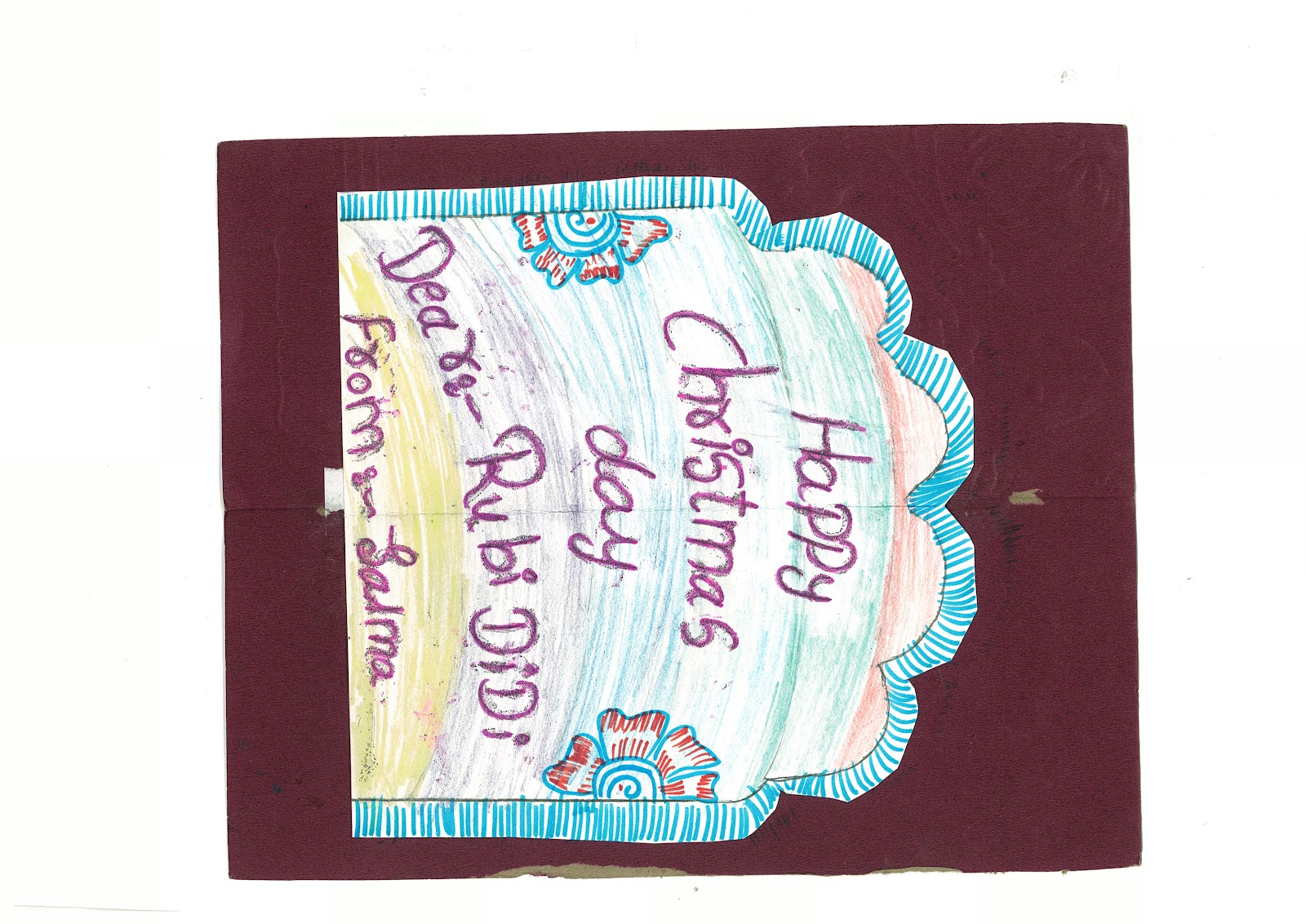
Many Santas! Christmas2011!
Told kids on 24th that since they think of themselves as 'hatke' people, they should celebrate Christmas in a 'hatke' manner. They were told that instead of depending on some one Santa, we'll all be Santas! Means? Well, they were supposed to get gifts for their classmates. Gifts whose value cannot be measured. That is, not anything that can simply be bought, but something that is handmade by them. And the gift that they can get for didi-bhaiyyaa is that they will study well in the class.
And just imagine what they did the next day! Beautiful cards- 3D folded, painted, written, ... Even boys did all of this! And Bushra got an earthen pot painted! And height of everything- Amreen got kheer made by herself and gave a spoonful to every bhaiyyaa-didi! They got multiple presents for their classmates and then argued that now they are eligible to give presents to didi-bhaiyyaa! So we had to accept, finally!
And what gift did didi-bhaiyyaa give them? A screening of one of Unicef Meena videos in which a sister and brother exchange their daily routine tasks for a day and the brother realizes how tough house work is and promises to help his sister everyday!




Tuesday, August 2, 2011
15th August 2011
An idea:
We can call kids for 2hrs, just like we do for weekend classes, maybe between 11am-1pm (their school flag hoisting gets over by 10am) or our usual time of 5pm-7pm and conduct this activity.
Advance work:
Prepare nice colourful friendly sheets which look like time-table in some sense. One sheet per child.
On the day:
1. Engage children in a discussion about what you do whole day. Share the things you do, responsibilities you take, etc with children. You'll have to make it easy to understand as well as interesting. This discussion is just to help them understand what exactly they need to fill in the sheet.
2. Distribute the sheets and ask kids to write about all the things/work they do whole day. Give them enough time for this.
3. Ask every student to read out what he/she has written. As the student reads it, ask others to conclude if that student is more dependent on others or more independent of others in his/her daily life. For example, a student who washes clothes and goes to school is more independent than some student who simply goes to school and does nothing else.
4. Thus, try to make two groups of students- more dependent and more independent. Lead the discussion in such a way that the dependent group concludes on its own that it needs to do something to become more independent. Ask them to write down this conclusion.
5. Ask each of the dependent group kids to specifically write about one particular responsibility that he/she would like to undertake, in order to be more independent. Ask them to take help of the independent group kids. Once they are done, collect the sheets.
6. Make everyone understand that it is not really a good idea to let someone else do your personal work. And those who do your personal work for you are actually "taking care of you".
7. Ask each of the dependent group kids to tie a raakhii to any of the independent group kids' hand, symbolising the actual meaning of "protecting / caring for". Even the young boys at Patil Estate think that girls are there to protect for. But this exercise can lead to- a boy tying raakhii to a girl. Make sure they understand that girls provide daily protection to boys.
8. Motivate dependent group kids to become independent and have a raakhii tied on their hands next time.
9. Thus celebrate "Independence Day"!
We can call kids for 2hrs, just like we do for weekend classes, maybe between 11am-1pm (their school flag hoisting gets over by 10am) or our usual time of 5pm-7pm and conduct this activity.
Advance work:
Prepare nice colourful friendly sheets which look like time-table in some sense. One sheet per child.
On the day:
1. Engage children in a discussion about what you do whole day. Share the things you do, responsibilities you take, etc with children. You'll have to make it easy to understand as well as interesting. This discussion is just to help them understand what exactly they need to fill in the sheet.
2. Distribute the sheets and ask kids to write about all the things/work they do whole day. Give them enough time for this.
3. Ask every student to read out what he/she has written. As the student reads it, ask others to conclude if that student is more dependent on others or more independent of others in his/her daily life. For example, a student who washes clothes and goes to school is more independent than some student who simply goes to school and does nothing else.
4. Thus, try to make two groups of students- more dependent and more independent. Lead the discussion in such a way that the dependent group concludes on its own that it needs to do something to become more independent. Ask them to write down this conclusion.
5. Ask each of the dependent group kids to specifically write about one particular responsibility that he/she would like to undertake, in order to be more independent. Ask them to take help of the independent group kids. Once they are done, collect the sheets.
6. Make everyone understand that it is not really a good idea to let someone else do your personal work. And those who do your personal work for you are actually "taking care of you".
7. Ask each of the dependent group kids to tie a raakhii to any of the independent group kids' hand, symbolising the actual meaning of "protecting / caring for". Even the young boys at Patil Estate think that girls are there to protect for. But this exercise can lead to- a boy tying raakhii to a girl. Make sure they understand that girls provide daily protection to boys.
8. Motivate dependent group kids to become independent and have a raakhii tied on their hands next time.
9. Thus celebrate "Independence Day"!
Subscribe to:
Posts (Atom)