Wednesday, September 10, 2014

Mathematical thinking and Sagar Chopde Patil!


9th and 10th Jan: Me, Hemant, Asim; all at Chopda! No class. :(
16/01/10: Only Sham and Akshay studied. Rest kept running around. Quite demoralizing! But are we not used to it? :D

17/01/10: Well, I had office so went an hour late. And guess what?! Ladies and gentlemen, please welcome, Asim and Hemant - new teachers at Pankhudi! These two were continuing the topics from last class so beutifully! I was stunned! Fractions and their arithmatic was the topic of study. And I saw kids painting chess board squares to denote 2/3rd, 1/10th, and so on! These are the concepts that really really need to be understood well. And the kids are really not good at these basic things still. Anyway. They could do it within a sqaure. What about dividing a circle?

23/01/10: Zarna. She continued the topic. Circle!

24/01/10: Chopda's here! Zarna's birthday. No class!

26/01/10: Empress Garden for ever! Lovely lovely day! Still, point to be noted is that these kids don't like common picnics! They want exclusively their batch picnics only!

30/01/10: Asim, Hemant, Sumeet and me! Naseer and one more new kid joins us. This is Sumeet's first class. We are still getting the area concepts right through the Indian map. Kids have been given the problem of making the Indian flag. They're to calculate how much each colour cloth will be required, how much total cloth will be required, and so on. The idea is that they learn areas through this activity. Sumeet and Naseer instantly pair up! Naseer = sincerety personified! Amazing guy! He just wants to work hard! I wish the others learn from him! Sumeet starts off with some combinatorics problems. Sham's full of creative thinking. Irfan and Akshay are number too. Naseer too, picks up. Pooja and Naseer stay back longer, solving the problem of finding the sum of first 72 numbers!


31/01/10: Hemant alone! All sitting near the river. They studied for some time. They all enjoyed the formations of boats in the river. Kids clicked a lot of photos through Hemant's phone. Then Hemant asked them to draw pictures of the river scene. Pooja drew beautifully. Some others were also not too bad. This is a good exercise. Can be extended in some other class full time.

06/02/10: Sagar Chopde Patil- the guy who's cycling the whole of India planting trees, was invited to the class. Kids interacted with him. It was an effort towards making them understand environmental issues. Sumeet's M.Prakash coaching officially started from this day. He was all set with all the textbooks.  Till post 8pm. Textbooks already with Sumeet.

07/02/10: Sham's creative intelligence marked the day! He solved Sumeet's questions amazingly. Others do not possess this ability. Only if Sham could concentrate better! Need to work on this. Class went on till post 5pm at BC, by the river. Till the time it was dark enough to not be able to read/write.

13/02/10: Class goes on from 5 to 8! Pooja and Nasir are the main culprits. These kids don't just stop studying! We're following their textbooks and studying everything chaper by chapter. Making them prove things. Of course, all this, under the able guidance of Sumeet. He's taking care of Pooja and I'm trying to keep the remaining junta occupied!

14/02/10: Record! 2pm to 7:30pm! Pooja's Maths textbook is nearly accomplished! Competition means a lot to her. She always peeps into Nasir's book to make sure that she's ahead of him. Nasir is least bothered about others. Completely concentrating on his work. Just that he's too weak in some basic concepts. He's done everything till date through the most used method so far: pattern matching. Hmmm... Let's see. Others couldn't keep up their patience beyond 1.5hrs.

Tuesday, August 13, 2013

Listen!

This happened on 25/07/2009. Just noting it here since it is one of those innovative activities that I now think should have been documented well. Today, many a times I find it difficult to explain to newer volunteers what kind of creative ideas we have been implementing apart from regular studies. 

Anyway, here it comes:

LOTS of new volunteers had come on that day. In those days, volunteers would just come to the little multipurpose community room inside Patil Estate without ANY orientation, which usually created more problems than any help to those conducting the class. Anyway. Had to involve all of them along with the kids.

Made 6-7 groups having 2 kids and 1 volunteer each. Explained the activity to all: We are to leave from this room and walk till Boat Club aka BC (inside CoEP, 8-10 minutes walk from the slum if all goes well, :-) ) with our mouths shut. We will only keep our eyes and ears and other senses open to reception and note things around us. We will discuss our observations only after we reach our destination.

And thus our mute parade reached Boat Club and settled. Only then we started speaking. Asked kids to be ready with their notebooks and pens. Then came the first discussion topic: "What did you observe? If you were to hypothetically label the observations as 'Good' or 'Bad' (their, or rather, everybody's favourite labelling), how would you do it?" Each of them were asked to speak one by one.

"Didi, I saw 2 boys fighting near lane no. 10. They were hitting each other! It was very bad!" -Irfan. Then we all discussed a bit on fighting and all of them decided- along with Irfan (at least in theory)- that it was 'bad'. All noted this down in the 'Bad' column in their notebooks. (Tip: Every activity can be so subtly linked with writing that kids never realize they are performing any writing tasks.) Now came the fun part. Since Irfan first observed this and termed this as 'bad', he should not indulge into it and set an example by never fighting! All of them noted this down eagerly so that it gets written down and they can refer to it later and remind Irfan!

This then happened for everyone. Kids remembered each others' points and kept reminding each other for the next couple of months. :')

Here are some of the other observations:
"That bridge we crossed was such a good bridge! I observed it. I will make one, one day!"
"People honk unnecessarily! Bad!"
"How they drove near that signal, didi! Too fast! Bad!"
"Because we didn't talk unnecessarily, we could observe so many things we never observed on our everyday route! Very good!"
"One car was giving out black smoke. Bad."
"They were leaving the taps open, letting water waste... Not good."
"I heard the birds!"
"There was too much noise outside but once we entered the campus, it is much better."
"There's a lot of garbage at the banks of the river."
"He tried to speak while on the way even when we all had decided not to!"
.
.
.

One of the volunteers asked me after the class: "Is this what you do? What's the whole point of this? I mean, what's the use?!"
Would you like to answer him? If yes, then please leave a comment! :')

Tuesday, February 28, 2012

Many Santas! Christmas2011!


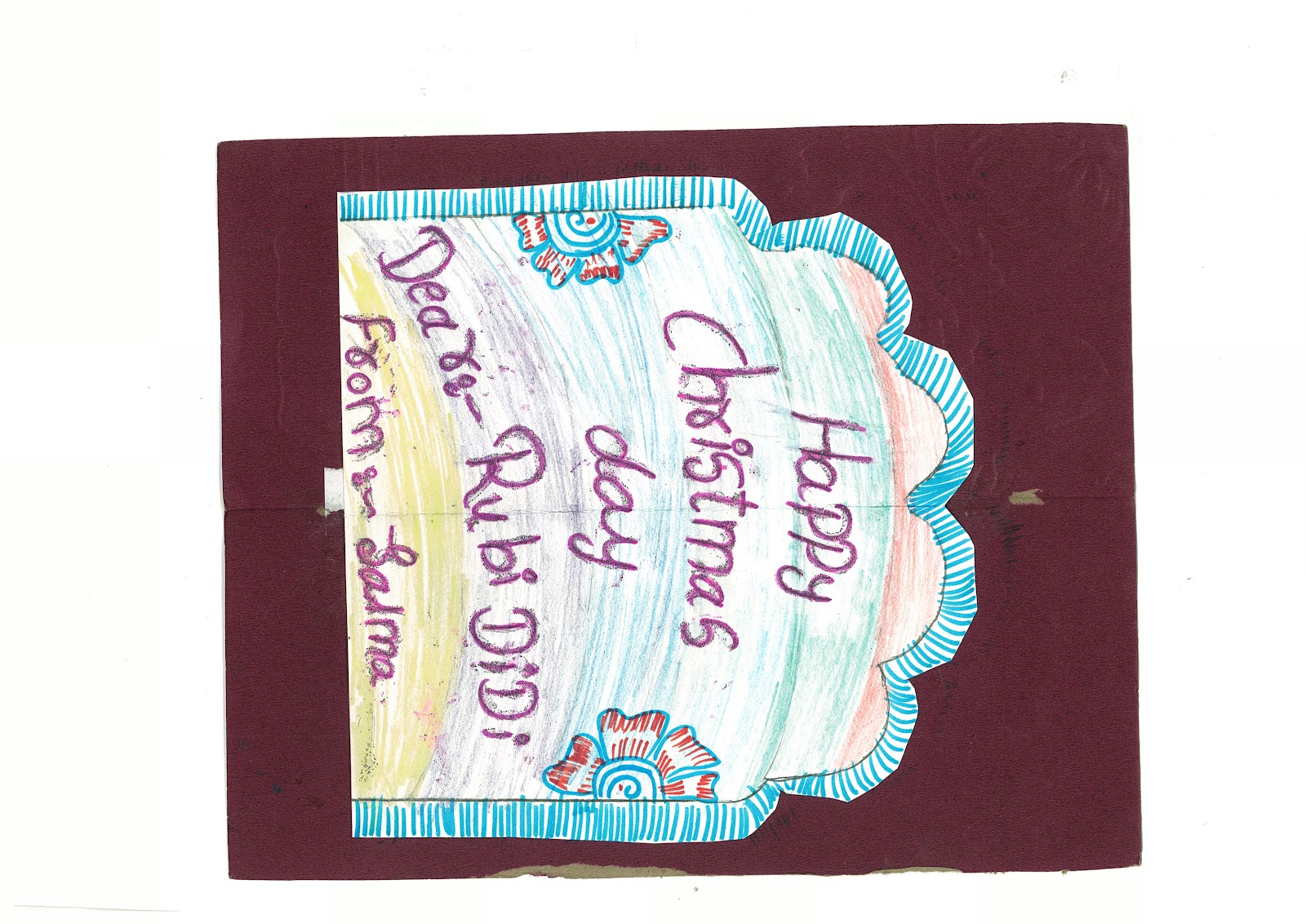
Told kids on 24th that since they think of themselves as 'hatke' people, they should celebrate Christmas in a 'hatke' manner. They were told that instead of depending on some one Santa, we'll all be Santas! Means? Well, they were supposed to get gifts for their classmates. Gifts whose value cannot be measured. That is, not anything that can simply be bought, but something that is handmade by them. And the gift that they can get for didi-bhaiyyaa is that they will study well in the class.

And just imagine what they did the next day! Beautiful cards- 3D folded, painted, written, ... Even boys did all of this! And Bushra got an earthen pot painted! And height of everything- Amreen got kheer made by herself and gave a spoonful to every bhaiyyaa-didi! They got multiple presents for their classmates and then argued that now they are eligible to give presents to didi-bhaiyyaa! So we had to accept, finally!

And what gift did didi-bhaiyyaa give them? A screening of one of Unicef Meena videos in which a sister and brother exchange their daily routine tasks for a day and the brother realizes how tough house work is and promises to help his sister everyday!

Wednesday, January 11, 2012

Translations!

There should be a lot of song and dance in the class! We're starting with simple poems; unlike the typically gruesome nursery hrymes!

Here's some poetry that SA exposed me to, when I was a child:

1)
Little drops of water,
Little grains of sand,
Make the great big ocean,
And the lovely land!

2)
This I learnt from the shadow of the tree
did sway upon a wall,
My shadow self, my influence,
May fall,
Where I may never be.

Just thought that this, being in English, may still seem complicated to kids. And if I actually study and explain it in the class like their textbook poems, they will stop thinking of it as simple poetry which they can hum anytime. And hence, a Hindi poetic translation is a must!

१)
ठुकराकर  मन की अकड़
बूंद  बूंद जब हो गए एक,
एक दूजे का हात पकड़
कण कण जब हो गए एक,
तब बना यह विशाल सागर
और बनी यह धरा मनोहर|

२)
एक पेड़  की परछाई
दूर दिवार पर थी छाई,
जिसे  देख मैं समझ पाई-
मेरा प्रभाव, मेरी परछाई,
वहा भी हो सकती हैं छाई,
जहा कभी मैं खुद न पहुच पाई|

Wednesday, November 16, 2011

Class update

Sunday 13th November 2011
  1. Only two volunteers- Ruby and Shivam. Very difficult to make kids come as the famous Marathi reality show "Home Minister" had come to Patil Estate. Went to every home and tried to convince parents and kids to come to class. 10 from 3A, 6 from 3B and 8 from Batch2 came finally. 
  2. Escorting was made easy by not shouting at kids at all and by just telling them once to be careful while on the road. Batch2 kids- Naseer, Sufia, Khushboo, Ruksar- were requested to help in escorting both times.
  3. 6pm- class starts. All kids were asked to sit in one class. There was only one rule- there will be no rules. Teacher sat on the podium and asked kids to sit wherever they like (Discipline is a relative term. It is we who attach a meaning of sitting straight on a particular bench to it. If kids concentrate better sitting wherever they like, then let that be the discipline!). 
  4. Immediately everyone circled the teacher and all tried to fit on the podium. Few batch2 kids sat on the last row benches and studied Math and asked doubts in between. Remaining joined all the younger kids. 
  5. Teacher asked kids what they would like to do today. "Story!" Thus started the story of one Diidii and one Bhaiyyaa. What do they do? "They teach us!" But that's only on Saturdays and Sundays. What do they do on weekdays? Do you know the weekdays? Can you recite all weekdays? Everyone shouted out the days of the week in their respective mother tongues. Are you smart enough to recite the days of the week in all the three languages that we all collectively know here? Then we all learned weekdays in Urdu, Marathi and English. 
  6. OK, so the story must go on. So then kids answered whatever they imagined about these Diidii-Bhaiyyaa. "On weekdays, Diidii-Bhaiyyaa must be having lunch, washing clothes, going to college, working, ..." OK. So let's find out how much time Diidii-Bhaiyyaa spend in these activities. How many hours do you go to school? If you attend school between 11am to 5pm, how many hours are these? Thus we solved some clock examples. 
  7. Story must go on... So then these Diidii-Bhaiyyaa who are just as busy as the kids during the week, have holidays on weekends. So they get up little late, do some pending tasks of the week and come to COEP at 4pm. Then they go to Pataangan. Then they go to every home and ask the kids to come to Pataangan. Somehow kids come and then they take the kids to COEP with some difficulty. By the time they reach the classroom, they are exhausted! Then they shout a lot, run around the classroom, teach something and get even more exhausted... So that's the dard-bharii daastaan of these Diidii-Bhaiyyaa.
  8. Sorry to have told you a very boring story having a sad ending. Would you like this story to have a happy ending? Would you like to reduce the dard of these Diidii-Bhaiyyaa? "Yes!" Then do something about it! You will be given twenty minutes to think and design some action plan which can help these Diidii-Bhaiyya. You are free to punish these Diidii-Bhaiyyaa if you think they are going wrong somewhere. Make groups of 4-5 among yourselves quickly, sit anywhere you like, one bhaiyyaa/diidii from Batch2 will be your group leader and under his/her guidance, you've to write down your action plan. 
  9. 2 kids didn't join any group and worked independently (Remember, no rules!). After about 40 minutes, everyone was done and we all huddled back on the podium. All groups read their list of rules. 4-5 kids had also written down 7 weekdays in three columns, in three different languages, without anyone asking them to do so!! 
  10. As each group finished reading, teacher asked the group members to tell out their names loudly so that we could clap for them. Teacher noted down these names and thus marked attendance (no extra effort or time is required to note the attendance!). All of us together consolidated the list and then everyone wrote down the final common list. Thus 3A and 3B kids made rules for their class. 
  11. A competition was announced for the coming class- During the week, kids are supposed to make a nice chart of these rules- using whatever resources they have- and bring it to the class on coming Saturday. The best three will be given very precious gifts (Teacher didn't tell the kids what gift it would be. It would be- the top three get to become the caretakers of their class!)! Naseer, Sufia, Khushboo, Ruksar from Batch2 were the ones who helped the younger kids. Pooja, Priti, Mahesh, Tushar studied Math. Class ended at 8pm. Kids were dropped back home by 8:30pm.

Tuesday, August 2, 2011

15th August 2011

An idea:

We can call kids for 2hrs, just like we do for weekend classes, maybe between 11am-1pm (their school flag hoisting gets over by 10am) or our usual time of 5pm-7pm and conduct this activity.

Advance work:
Prepare nice colourful friendly sheets which look like time-table in some sense. One sheet per child.

On the day:
1. Engage children in a discussion about what you do whole day. Share the things you do, responsibilities you take, etc with children. You'll have to make it easy to understand as well as interesting. This discussion is just to help them understand what exactly they need to fill in the sheet.
2. Distribute the sheets and ask kids to write about all the things/work they do whole day. Give them enough time for this.
3. Ask every student to read out what he/she has written. As the student reads it, ask others to conclude if that student is more dependent on others or more independent of others in his/her daily life. For example, a student who washes clothes and goes to school is more independent than some student who simply goes to school and does nothing else.
4. Thus, try to make two groups of students- more dependent and more independent. Lead the discussion in such a way that the dependent group concludes on its own that it needs to do something to become more independent. Ask them to write down this conclusion.
5. Ask each of the dependent group kids to specifically write about one particular responsibility that he/she would like to undertake, in order to be more independent. Ask them to take help of the independent group kids. Once they are done, collect the sheets.
6. Make everyone understand that it is not really a good idea to let someone else do your personal work. And those who do your personal work for you are actually "taking care of you".
7. Ask each of the dependent group kids to tie a raakhii to any of the independent group kids' hand, symbolising the actual meaning of "protecting / caring for". Even the young boys at Patil Estate think that girls are there to protect for. But this exercise can lead to- a boy tying raakhii to a girl. Make sure they understand that girls provide daily protection to boys.
8. Motivate dependent group kids to become independent and have a raakhii tied on their hands next time.
9. Thus celebrate "Independence Day"!

Tuesday, February 1, 2011

Fruity fractions!

My mom's way of teaching fractions made me think a little more and come up with this:

Make 3-4 groups of 4-5 kids each. Ask a question. Whichever group solves it first, gets an apple. Whichever group solves it second, gets a guava. Whichever group solves it third, gets a chickoo. And so on. Kids in one group have to share one fruit. Let them cut it and share it. Let them discover what happened when they cut one whole fruit into pieces.

In a group of four, 1 apple cut into 4 pieces would give every kid 1 piece out of those 4 pieces. That is, 1/4.

Let them rejoin the cut pieces and make the original fruit, until they understand that 1/4 + 1/4 + 1/4 + 1/4 = 1.

Finally, let them eat the fruit! Keep supplying fresh fruits until they learn well. No harm in eating lots of fruits.

Next level would be to have different number of kids in different groups, so that different fractions come up for each group. Kids will understand that more kids in one group => less fruit per head. Hence they will also learn inequalities like 1/4 > 1/5.

Next level would be to have the same fruit for every group. Let them cut and share it withing a group. Let them bring together all pieces. Let them count the pieces. Let them add the pieces and learn about fractions greater than 1!

In each level, one can teach subtraction whenever some kids eat some pieces.

The game can be easily extended further for explaining many more concepts having fractions. One may use chocolates which have markings for breaking into pieces. One may use paper cards, if eatables become too messy. But I like the idea of eating/subtracting while studying! :D